Storage & dosing silos for coffee
The control layer of intake, roasting, grinding and packing
Coffee silos are often introduced to solve a storage problem. In modern roasteries, they do much more. With silo storage, coffee moves exactly when production requires it, freeing operators from constantly feeding machines. For green coffee, silos change how coffee is received, handled, dosed and fed into roasting, decoupling intake from production and stabilizing roasting operations. For roasted coffee, silos synchronize production by creating a buffer between batch roasting and continuous grinding and packaging operations. At Roastworks, we engineer silo and dosing systems that transform storage into an active control layer, protecting coffee quality while keeping production efficient and ready to scale.
Why silos deserve proper engineering
Production stability across the process
Accurate dosing and full traceability
Improved operator safety and efficiency
Better use of available space
Storage architectures we offer
Every very building and production flow is different. Storage architecture must adapt to available space, production volumes, number of origins handled, blending needs, desired automation level and expansion plans.
Roastworks has engineered and installed hundreds of silos for green, roasted and ground coffee, providing practical insight into reliability, maintenance realities and long-term operational performance. We use a comparative framework to guide early engineering decisions, helping select the silo architecture that best fits operational reality
Circular silo 16-cells
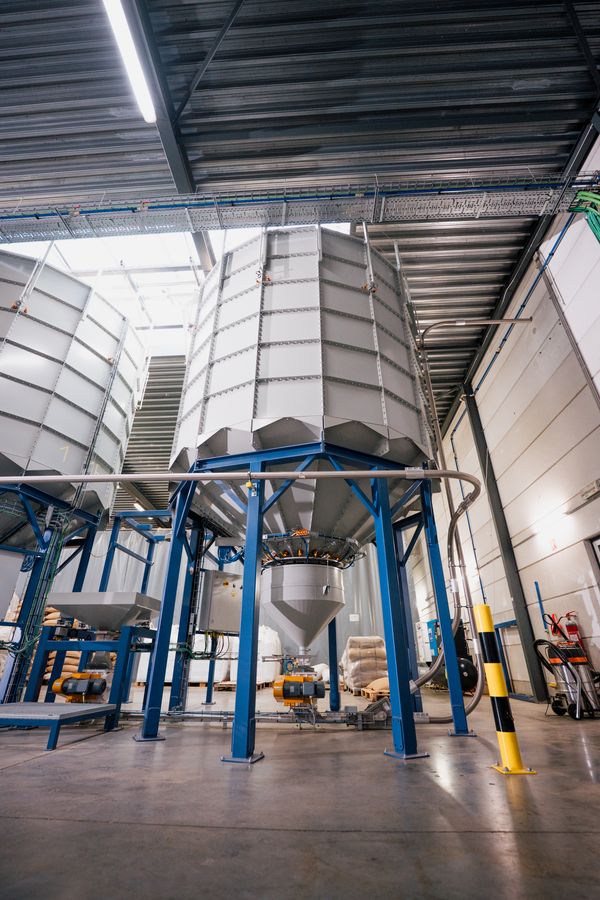
A 16-cell architecture organized around a central structure, with one rotative distribution arm feeding all cells and a central discharge hopper collecting flow for weighing, dosing and blending. Best for high-throughput plants needing economical multi-origin intake, centralized weighing and blending and reliable distribution to multiple production lines.
Linear silo
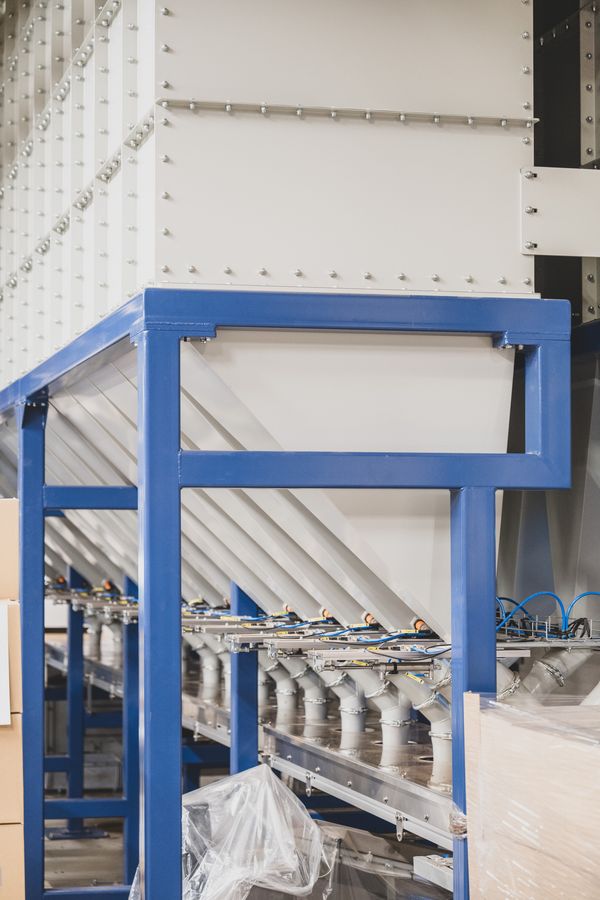
Cells are aligned along walls or narrow layouts, with sizes adapted to production needs and building geometry. A strong choice for retrofits or buildings where centralized silo towers cannot be installed and storage must integrate along existing walls.
Modular silos
Independent cylindrical cells installed progressively as production grows. Each cell operates independently and can be added step by step as needs evolve. Ideal when production grows gradually, investment must follow demand, or when building constraints prevent centralized silo installations.

| Criterion | Modular (round) | Circular 16 cells | Linear (square or circle) |
|---|---|---|---|
| Flow stability | |||
| Product gentleness | |||
| Degassing performance | |||
| Blending integration | |||
| Space optimisation | |||
| Automation readiness | |||
| Expansion readiness | |||
| Maintenance & cleaning | |||
| Initial investment (€) | |||
| Cost per kg stored | |||
| Operational simplicity | |||
| Integration flexibility |
Highlights - Green coffee storage
Integrated dust control
Green coffee discharge generates dust, especially at hopper and dosing interfaces. Integrating local extraction and airflow control into silo discharge minimizes dust dispersion and creates cleaner, safer environments.
Safer intake and reduced handling
Operators feed the silo rather than the roaster directly. Handling pallets or big bags instead of sacks - or scooping manually - drastically reduces handling effort, lowers physical strain, and prepares production for future automation and growth.
Roasting production and blending simplified
When synchronized with production software, operators select roast profiles while the system automatically draws coffee from the correct cells and delivers required quantities. Feeding coffee to the roaster becomes reliable and repeatable without manual loading.
Highlights - Roasted coffee storage
Bean integrity protection
Roasted coffee is fragile. Impact-absorbing discharge solutions reduce bean breakage when coffee enters the silo.
Controlled degassing
Degassing valves allow CO₂ to escape while coffee rests safely. When synchronized with production software, coffee can remain in a cell until degassing is complete before downstream release.
Flexible blending integration
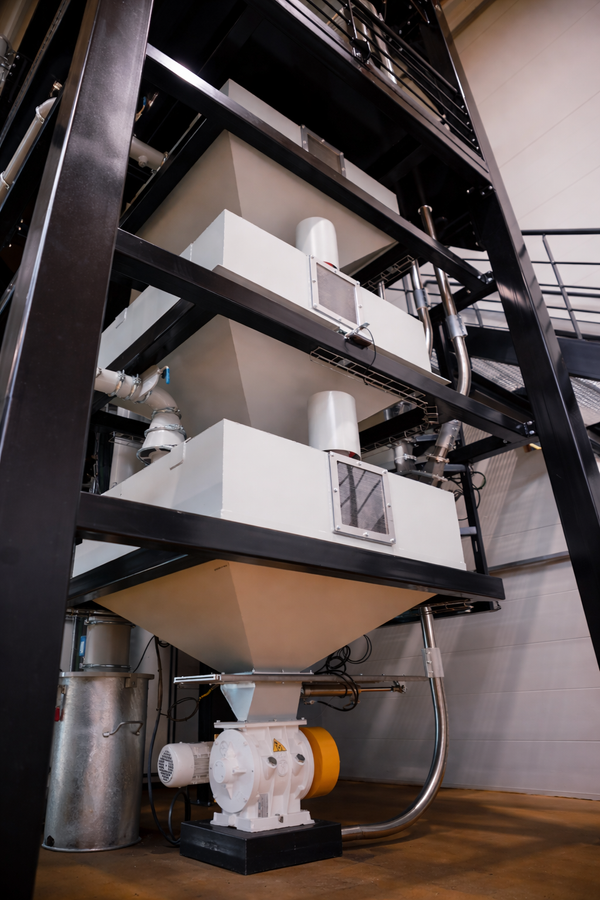
With a blender installed below centralized silos, coffees are portioned, blended and automatically sent downstream.
Automation & weighing - Engineered together
Integrated weighing ensures precise and repeatable dosing for single origins and blends while maintaining real-time inventory visibility. Sliding valves at the bottom of silo cells enable accurate bean dosing, while self-learning fall correction continuously refines accuracy.
Production software determines which coffees are required, how much must be dosed and when machines should be fed, allowing roasting and downstream processes to run with minimal manual intervention.
Modularity & scalability - Planned, not oversized
Roasteries often operate with ambitious growth plans. Doubling production within a few years - sometimes much faster - is common.
This requires modular layouts, anticipating future equipment and preparing routing so additional silos or machines can be integrated without costly retrofits. Good engineering builds a predictable roadmap for expansion without premature investment.
The goal is simple: control CAPEX today while preserving flexibility tomorrow.
Engineering approach - Designing silos that work
A silo performs best when engineered as part of the full production flow, from intake to roasting and downstream processing.
Our engineering approach begins by understanding:
- Fire safety and ATEX requirements
- Interfaces with roasting, conveying and downstream equipment
- Current production volumes and growth expectations
Depending on the project, we either translate a defined specification into a robust design or help shape the specification.
From there, we engineer:
- Silo architecture, number of cells and usable storage volume
- Integration with roasting, blending, grinding and packaging
- Gentle product handling and controlled degassing
- Conveying interfaces upstream and downstream
- A realistic expansion roadmap
Questions? We’re here to assist.
Silo capacity depends on roasting volume, number of coffees handled, delivery frequency and how much production buffering is required between intake, roasting and downstream operations.
Yes. With integrated weighing and automation, silos can portion and combine coffees automatically, allowing repeatable blend preparation and reliable dosing to roasters, grinders or packaging lines.
When engineered correctly from the start, additional cells, new conveying routes or downstream equipment can be integrated later without major reconstruction or production interruption.