Charles Liégeois
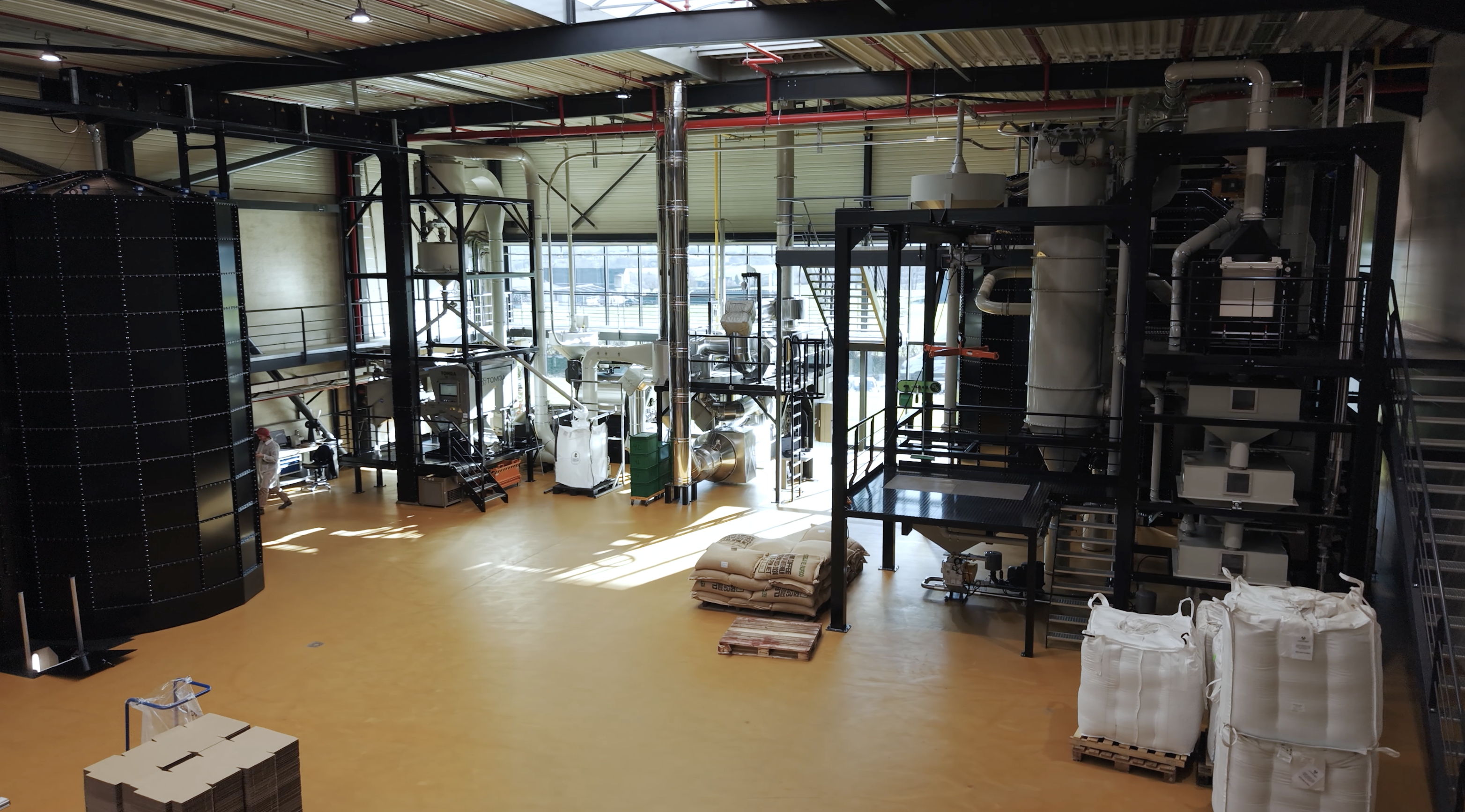
Café Liégeois is one of Belgium's most established coffee companies, producing around 5,000 tonnes of coffee annually across its operations. But when the company decided to create a new roasting facility dedicated exclusively to premium coffees, the objective was not simply to increase capacity.
The goal was to create a roasting environment capable of delivering exceptional quality, complete process control and long-term scalability, while remaining flexible enough to adapt to future technologies and market demands. Because when you're investing for the next 20 to 25 years, every decision matters.
The ambition: combining artisan quality with industrial precision
For decades, Liégeois had successfully operated a large-scale production facility. The new site in Thimister would be fundamentally different.
CEO Benoît Liégeois envisioned a roasting facility focused entirely on high-quality coffees, where every aspect of the process could be optimized for consistency, flavour development and product quality.
The challenge was balancing two priorities that are often difficult to combine. On one side, the facility needed advanced automation and operational efficiency. On the other, it needed to provide the flexibility and control required to produce coffees at the highest quality level.
The objective was clear: create a roastery capable of delivering exceptional coffee today while remaining ready for future growth tomorrow.
Starting with trust
The relationship between Liégeois and Roastworks did not begin with this project. For more than twenty years, Liégeois had worked together with Schuilenburg - a Belgian distributor of different quality coffee brands - through the roasting equipment and technical support.
More recently, Café Liégeois implemented Roasthubs, the Roastworks' coffee production software, within its industrial roasting facility. The results created confidence.
Benoît experienced first-hand how the software improved operational control and provided meaningful value throughout the production process. When plans for the new roasting facility became reality, continuing the partnership felt like a natural next step.
The project required more than equipment. It required a partner capable of understanding the entire roasting process.
Co-creating the future facility
The project itself was years in the making. Long before acquiring the building, Café Liégeois had spent years studying roasting facilities, evaluating technologies and defining exactly what they wanted to achieve.
Once the vision became clear, discussions started with various suppliers.
What followed with Roastworks was not a traditional customer-supplier relationship. It became a genuine co-creation process. Ideas flowed in both directions. Operational experience from Café Liégeois was combined with engineering expertise from Roastworks. Together, those ideas evolved into a facility designed around quality, flexibility and long-term growth.
As Benoît describes it: "Roastworks ultimately became the architect of the entire project. From process layouts and piping design to software integration and automation strategy, Roastworks took responsibility for transforming the concept into a complete roasting operation.”
Quality designed into every step
The focus on quality extends far beyond the roaster itself. The installation was engineered to minimize bean damage, maximize roasting consistency and eliminate defects wherever possible.
The facility includes:
- Automated green coffee intake and storage.
- Green coffee silos for blend management.
- A roaster with regenerative technology and air recirculation.
- Advanced process control through Roasthubs.
- TOMRA optical sorting technology for defect and quaker removal.
- Automated roasted coffee handling and storage.
- High-precision packaging systems for both whole bean and ground coffee.
Every process step was designed to protect product quality while reducing variability. The result is a roasting operation capable of delivering exceptional consistency batch after batch. According to Benoît, the quality level they achieved, was almost unmatched.
Engineering for reliability and flexibility
For Christophe Legrain, Maintenance Manager at Café Liégeois, another objective was equally important. As production systems become more sophisticated, accessibility and maintainability become critical.
Rather than only optimizing for normal operation, the project team considered what would happen when problems occur. What if a silo needs to be emptied? What if a sorting system requires maintenance? What if part of the process becomes temporarily unavailable?
The facility was therefore designed with multiple bypass options, automated discharge systems and alternative process routes. This allows production flexibility without depending entirely on a single component.
The philosophy is simple: When challenges occur, the operation should continue wherever possible. That design approach improves reliability, simplifies maintenance and creates long-term operational resilience.
Scaling without rebuilding
The facility currently operates with a single Probat PX120 roaster and a production capacity of approximately 500 tonnes annually. With two shifts, capacity can increase to 1,000 tonnes. Adding a second roaster increases annual capacity to approximately 2,000 tonnes.
Importantly, this future expansion can be achieved without major modifications to the existing infrastructure. The packaging systems, storage capacity and process design were all engineered with growth in mind. The result is a facility designed not only for today's requirements, but for the next phase of development as well.
A partnership built on shared expertise
For Café Liégeois, the success of the project ultimately comes down to collaboration.
The combination of operational knowledge from the roastery and engineering expertise from Roastworks created something neither party could have achieved alone.
As Benoît explains: "By combining our knowledge with theirs, we were able to create something truly exceptional."
That is what partnership looks like in practice. Not simply supplying equipment. But designing, integrating and continuously improving a roasting operation built for quality, scalability and long-term success.