Cafés Delahaut
Growing a historic roastery while preserving craft
Cafés Delahaut is one of Belgium’s historic coffee roasters. Founded in 1864 by Léon Delahaut, the company has remained a family business for four generations.
Today it is led by François Delahaut, who took over the roastery fifteen years ago together with his brother and his wife.
For more than a century, the company operated within the walls of Namur, serving a loyal regional market. But when the new generation took over, they began looking further ahead, expanding beyond the city toward Brussels and the wider Walloon region.
That strategic shift triggered a new phase of growth. When François took over the company, annual production was around 40 tonnes of coffee per year. Today, the roastery produces around 350 tonnes.
The challenge: growing beyond the limits of the old roastery
The growth quickly exposed a structural limitation.
The historic roastery in Namur had simply become too small to support the company’s ambitions. Expanding production inside the existing building was no longer realistic.
Rather than gradually adapting the old facility, François decided to take a different approach: designing an entirely new roastery built around efficiency, technology and future capacity.
The goal was not only to increase output, but to create a production environment that would support long-term growth.
Building a roastery designed for workflow
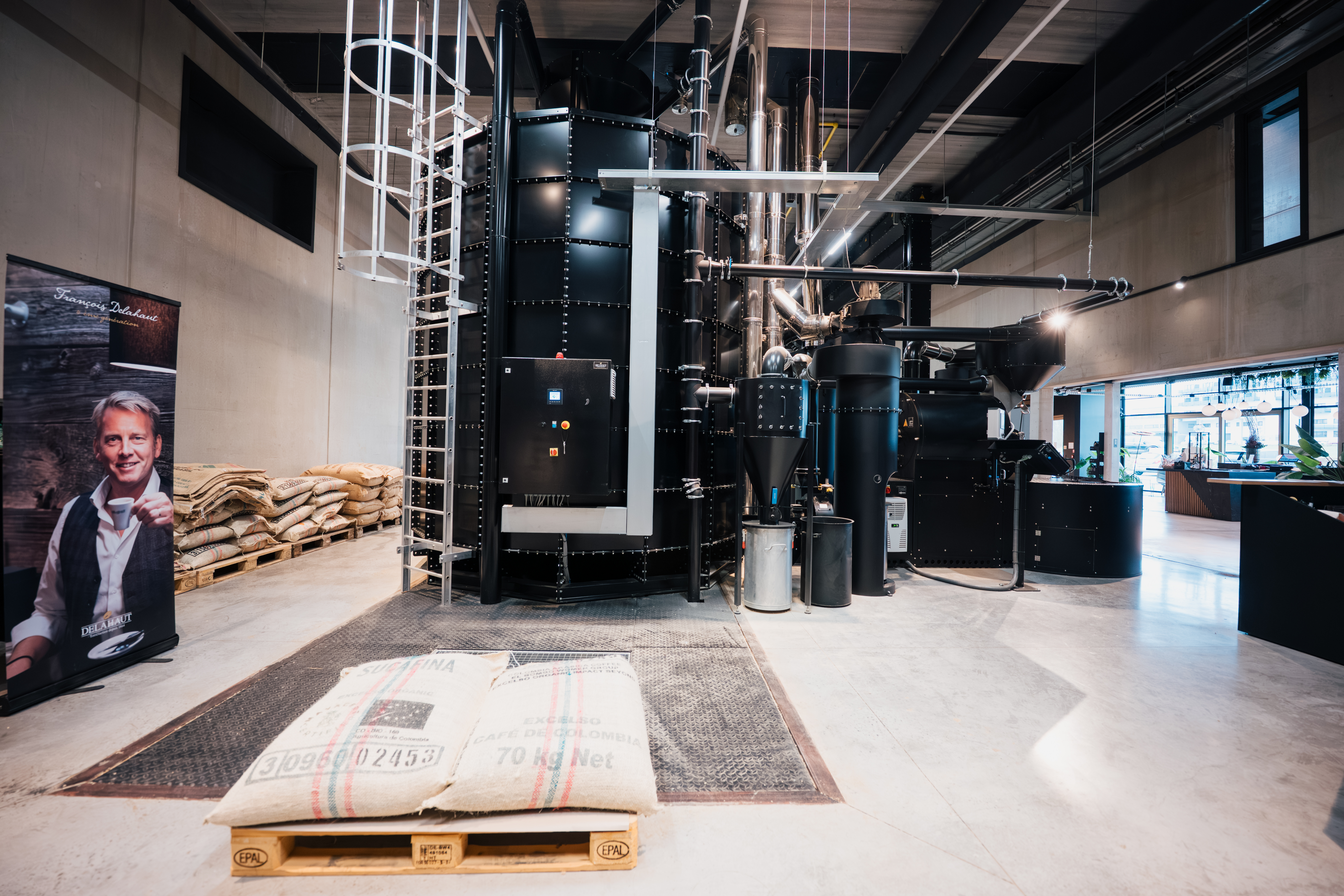
The new facility was designed around the equipment and the production flow.
Storage for green coffee is located directly next to the green coffee silos. Roasted coffee storage next to the roasted coffee silos. Every part of the process was arranged to minimize unnecessary movement and simplify daily operations.
The roastery operates with a 60kg roaster, capable of roasting around 50-kilogram batches every fifteen minutes. While the roaster itself occupies only a small footprint in the building, the entire production setup around it allows the operation to run efficiently and predictably.
And the design leaves room for growth.
Today we produce around 350 tonnes of coffee per year, but we could easily reach 700 tonnes simply by increasing production.
Efficiency through technology
One of the biggest changes over the past fifteen years has been operational efficiency.
When François first took over the company, roasting and packaging required a team of several people. Today, technological improvements allow a single operator to manage the entire process.
A roaster can handle roasting in the morning and continue with packaging and conditioning later in the day.
That efficiency matters in an industry where many cost factors, especially the price of green coffee, are outside the roaster’s control.
We cannot control the price of green coffee, but we can control our internal efficiency.
Automation and modern equipment now allow one person to perform work that previously required multiple operators, creating a significant economy of scale.
Craft preserved through precision
Despite these technological improvements, Cafés Delahaut has always remained committed to its identity as an artisan coffee roaster. That philosophy shaped the way the new roastery was built.
Instead of reinventing their roasting approach, the team reproduced their traditional roasting methods in the new facility. The roasting philosophy stayed the same only the equipment evolved.
Automation helps reduce small human errors and allows roasting curves to be followed with precision.
Whether the coffee is roasted by Tom, Frédéric or another roaster, the result will always be consistent.
The result is a combination of craft tradition and modern reliability.
One partner across the entire production chain
When building the new roastery, Cafés Delahaut also made a deliberate strategic choice: working with a single partner for the entire production chain.
From green coffee handling to roasting, grinding and packaging, all equipment is integrated under one responsibility.
That decision was driven by operational clarity. Having one partner ensures that ownership remains clear when technical questions arise and allows the system to function as a coherent whole.
A roastery designed to be seen
The new building also reflects another important value: openness.
In the previous roastery, the production process was spread across three floors, making it difficult for visitors to see the full process.
The new roastery was designed on one single level, allowing customers and visitors to experience the entire journey of coffee, from green beans to roasting and packaging.
Even as production has grown, the company remains committed to roasting in relatively small batches and maintaining the transparency that defines artisan roasting.
A living roastery
For François, the most striking moment is still arriving at the roastery in the morning.
What amazes me most is the life inside the building.
People are moving through the space. Coffee is being roasted and packaged. Customers are having breakfast. Visitors are watching the process. Colleagues meet in the café or the meeting rooms.
The roastery is not only a production facility, it is a place where coffee culture, craftsmanship and community come together.
And for François Delahaut, that is something he remains deeply proud of.