Beans Coffee
Scaling without losing control
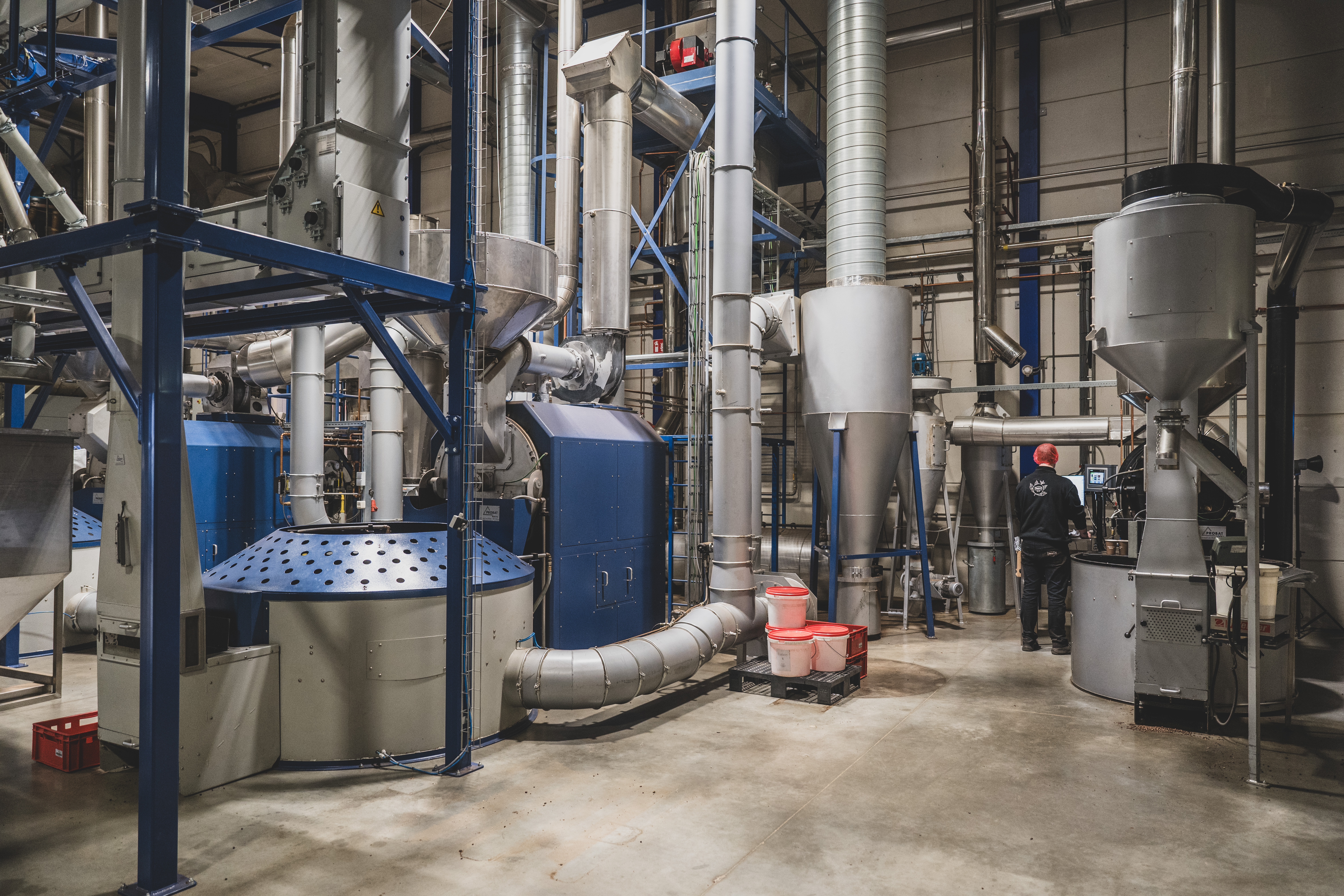
Beans Coffee is a roastery built for consistency and throughput, operating in a high-output environment where uptime and operational control matter just as much as coffee quality.
Today, Beans Coffee produces around 1500 tons per year. But the ambition is clear: within four years they want to scale production toward 5000 tons per year, while staying in the same building.
That combination is challenging. Increasing volume is one thing. Doing it while keeping processes stable, predictable, and resilient is something else.
The situation: scaling a roastery without room for downtime
Paul, CEO of Beans Coffee, first came into contact with us through Probat. What started as a conversation about expansion developed into something longer-term: supporting a roastery where reliability, continuity and service matter every day.
Because at Beans Coffee, downtime is never minor. When a breakdown happens, it immediately affects daily production. Every disruption becomes operationally critical and the difference between a short delay and a full disruption often comes down to response time, technical experience and knowing exactly what to do next.
The real need: service certainty, not just equipment
Over time, it became clear that Paul wasn’t only buying technical specifications. He was buying certainty: the confidence that when something unexpected happens, the roastery won’t be left alone to manage the consequences. In a production environment where every hour counts, support needs to be fast, practical, and grounded in real operational experience. That reliability creates space to keep producing with confidence, even under pressure. And at scale, it becomes a competitive advantage in its own right.
Trust, people and ownership
They did consider alternatives. Competitors were on the table. But the decision didn’t come down to comparison lists. It came down to something more fundamental: trust and service reliability.
Paul is highly satisfied with product quality and support, and explicitly credits the people behind the service, whose support stood out and strengthened the relationship over time.
He emphasized that long-term value is created through consistency and human expertise, not only technical performance.
That long-term consistency really matters. Because in the moments that count - when production is under pressure - you don’t want uncertainty. You want a partner you trust to act quickly and take ownership.
One partner, one line of responsibility
In a modern roastery, equipment rarely operates in isolation.
As production grows, the expectation shifts from individual equipment performance to systems working together. And that is where the operational risk increases: when responsibility is spread across multiple parties, even simple issues can become frustrating to resolve.
Paul has seen this firsthand. The most difficult situations aren’t necessarily technical. They happen when ownership isn’t clear.
Friction mainly happens when responsibilities between parties aren’t clear.
That is exactly why having one integrator makes a measurable difference. Instead of coordinating between suppliers, Paul values having a single point of responsibility: someone who owns the problem, aligns the right people and drives the solution forward.
It’s not about replacing expertise. It’s about making sure the outcome is owned.
Scaling to 5000 tons without moving facilities
The next step is ambitious: scaling production toward 5000 tons a year, while staying in the current facility. That goal depends on more than capacity. It depends on stability.
As output grows, the cost of interruptions rises sharply and the need for clear ownership and integrated thinking becomes even more important.
Paul sees that direction in the market as well: Integrated solutions across machines and systems are becoming increasingly important.
A partnership built around continuity
The story of Beans Coffee is not about chasing the newest solution. It’s about building an operation that runs consistently under real production pressure. And choosing a partner who supports that outcome with technical experience, responsiveness and clear ownership.
In Paul’s words:
You guys ensure that our production continues to run smoothly thanks to its strong service, technical experience and integration mindset.
That is what long-term partnership looks like in practice: calm, accountable and built for continuity.